SHADOW CHANNELS DOC 6
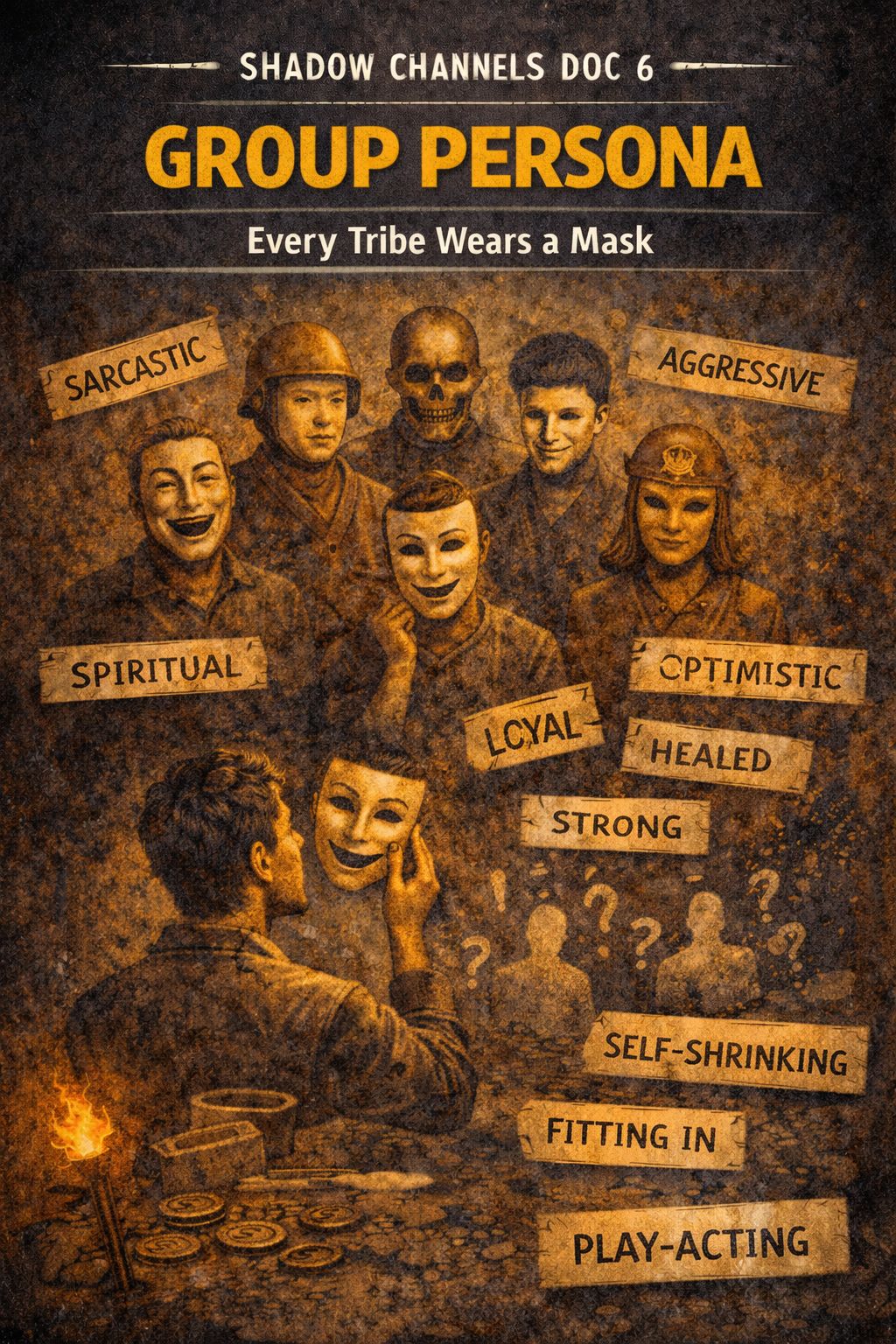
GROUP PERSONA
Every Tribe Wears a Mask
What It Is
Groups don’t just gather people.
They create a shared identity that acts like a costume.
The Group Persona is the face a community shows the world and the tone it pressures members to adopt.
It’s the unwritten rulebook of:
- how we talk
- how we joke
- how angry we get
- how spiritual we sound
- how intellectual we pretend
- how broken or healed we’re allowed to appear
- what we mock
- what we praise
- what we avoid
It isn’t decided.
It emerges.
Why It Matters
The Group Persona sets the emotional weather in the room.
Members adapt or risk exile.
It turns a collection of individuals into:
- a vibe
- a flavor
- a posture
- a chorus
But it also shrinks people who don’t match the mask.
Individuals become:
- smaller
- quieter
- louder than they want
- harsher than they are
- more agreeable than they feel
- or totally different versions of themselves
just to survive the persona.
Where It Shows Up
You’ll see Group Persona in:
- AA meetings
- friend circles
- churches
- fan groups
- work crews
- political movements
- Facebook groups
- families
- D&D tables
- even trauma support spaces
Every room has a center of gravity:
If you’re in the room long enough, you start to match it.
The Deep Structure
Humans are wired to sync:
- heart rates
- behavior
- language
- beliefs
- emotions
Group Personas form because:
- belonging feels safer than authenticity
- copying reduces friction
- shared tone signals loyalty
- mimicry prevents conflict
- sameness feels like protection
- individuals fear sticking out too far
No one decides the Persona. Everyone co-creates it by small imitation.
When Persona Turns Toxic
Watch for:
- banter masking loneliness
- cynicism blocking vulnerability
- spiritual language hiding confusion
- positivity shaming pain
- “toughness” punishing tenderness
- political certainty crushing nuance
- leaders freezing evolution
- newcomers quietly shape-shifting to fit
Persona becomes a cage when the mask is non-optional.
Healthy Questions
- Who am I in this room that I am not anywhere else?
- What emotions does this group reward?
- Which ones does it punish?
- Do I feel more “me” when I leave?
- What would happen if I brought my real voice in here?
Breaking the Persona Spell
One person, showing up as themselves, disrupts the whole pattern.
A quiet admission.
A different tone.
A gentle “I don’t feel that way.”
That’s how Permission Cascades begin.
When one person de-masks, others exhale.
Signs You’re Free of the Persona
You:
- speak from experience instead of phrasebook slogans
- don’t rehearse before talking
- stop scanning the room for clues
- laugh for real
- use your own vocabulary
- feel slightly scared and slightly relieved
- notice people leaning toward you, not away
That’s authenticity cracking the shell.
Application: One-Sentence Tool
“A mask that requires me to disappear is not my tribe.”
Shadow Channel Link
- Norm Debt sustains the Persona
- Audience Capture performs it
- Armor Maintenance defends it fiercely
- Narrative Gravity gives it myth
- Permission Cascades melt it
- Exit Wounds appear when you quit wearing it
Every persona was once adaptive
and every persona expires.
Landing Reflection
If I brought my whole self into this group, what would change first — me or the room?
Index of Shadow Channels
- THE SHADOW CHANNELS
A Map of the Invisible Forces Beneath Belonging - 1 - Norm Debt
The silent costs we pay to stay accepted. - 2 - Narrative Gravity
The story-fields that keep us in orbit long after the meaning dies. - 3 - Permission Cascades
Invisible domino lines that tell us what’s allowed, expected, or forbidden. - 4 - Armor Maintenance
The labor of defending identity when doubt scratches the door. - 5 - Audience Capture
Becoming the character our watchers expect instead of the one we choose. - 6 - Group Persona
The shared mask a community adopts to smooth over conflict and complexity. - 7 - Story Exit Wounds
The emotional scar tissue from leaving one identity and stepping into the next. - Closing Arc
The seven channels form a journey