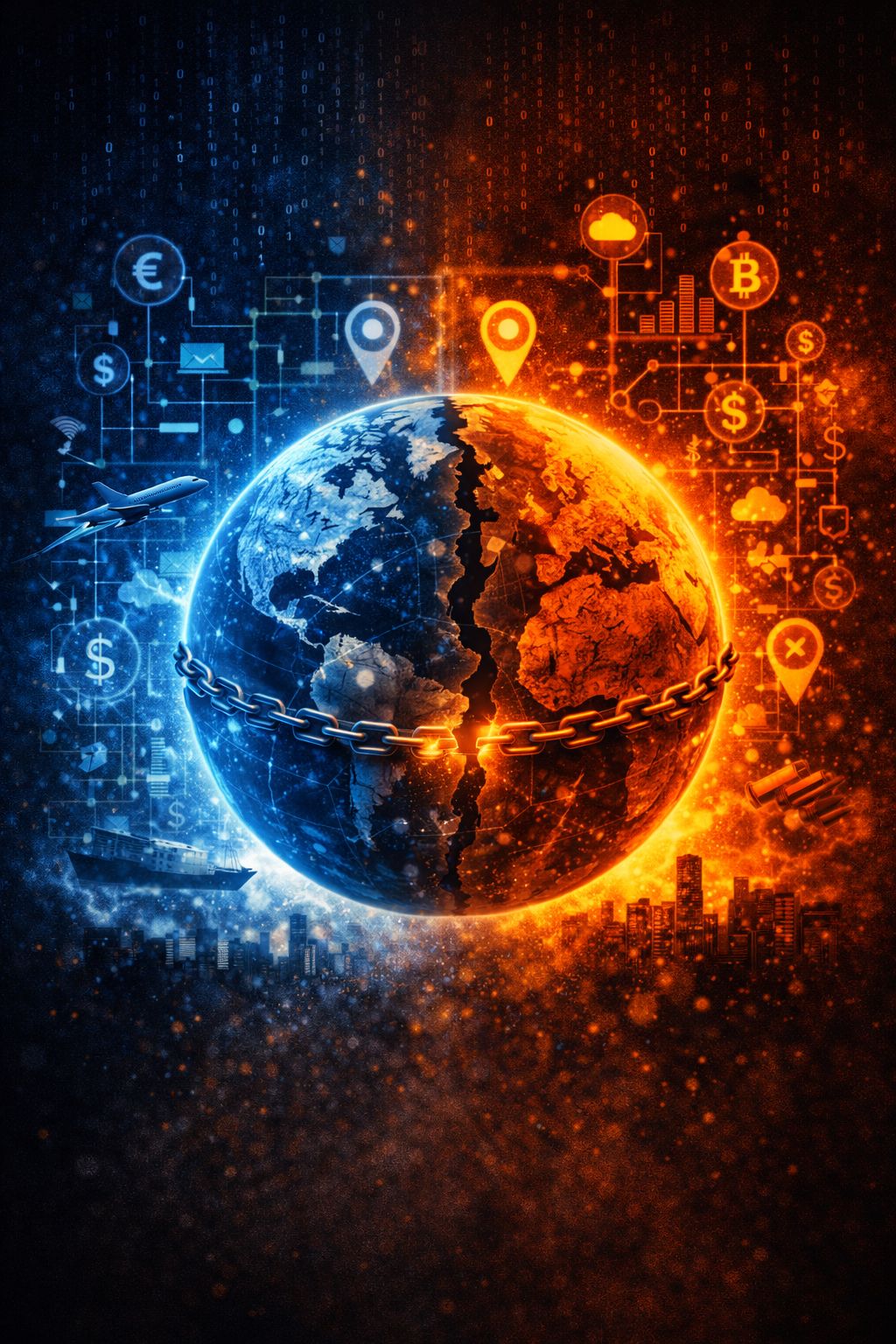
To understand why symbolic figures gained so much influence so quickly, we have to examine the environment surrounding them:
👉 globalization.
Not simply as economics or international trade, but as the collapse of distance across every dimension of human life.
For most of history, geography shaped identity.
People generally:
Distance acted like a psychological buffer.
Globalization dissolved that buffer.
In the modern digital world, cultural contrast is unavoidable.
Within seconds, a person may encounter:
Each piece of content represents a potentially incompatible reality framework.
The sheer volume of difference creates psychological friction before conscious analysis even begins.
Difference itself is not necessarily the problem.
The speed is.
Human nervous systems evolved for gradual cultural adaptation.
Historically, major worldview shifts unfolded across:
Today, identities collide continuously in real time.
Ideas arrive faster than the nervous system can integrate them.
Under these conditions:
👉 unfamiliarity stops feeling interesting
👉 and starts feeling destabilizing
Globalization turns nearly everyone into a minority somewhere within their daily information stream.
Even when no explicit threat exists, the nervous system may still register instability.
Terror Management Theory predicts this reaction with surprising precision.
When worldview certainty weakens and identity boundaries blur, mortality anxiety increases.
A destabilized identity can feel psychologically similar to symbolic death.
Questions begin emerging beneath the surface:
“If other identities are rising, does ours survive?”
“Are we being replaced?”
“What happens if the old norms disappear?”
These are existential fears disguised as political or cultural opinions.
In periods of rapid uncertainty, symbolic figures become emotionally stabilizing.
They do more than entertain.
They define reality when reality feels unstable.
They redraw psychological borders when cultural borders feel dissolved.
They transform chaos into narrative:
This rhetoric lands powerfully because it validates threatened identity structures.
Sociologists describe part of this experience as:
👉 Cultural Proximity Stress
This refers to the tension created by constant exposure to unfamiliar:
When difference exists far away, it feels abstract.
When difference becomes constant and immediate, it can feel disruptive.
Identity shifts from stable inheritance into perceived competition.
Technology intensifies globalization by accelerating emotional exposure.
The internet does not simply expose people to difference.
It exposes them to conflict about difference.
And conflict travels faster than understanding.
Algorithms frequently reward:
Nuance moves slowly.
Outrage spreads instantly.
Over time, populations become conditioned to interpret cultural change primarily through threat perception rather than curiosity.
Globalization also weakens many traditional identity structures.
Older anchors lose influence relative to digital identity systems:
As these older structures loosen, symbolic figures become substitute anchors.
Portable leaders for unstable times.
People no longer inherit allegiance.
They subscribe to it.
This is why modern cultural conflict feels unusually intense.
People are often not merely debating policies or preferences.
They are unconsciously defending:
The emotional stakes feel existential because, psychologically, they are.
Psychological tension created by constant exposure to unfamiliar beliefs, identities, and lifestyles.
The weakening or destabilization of previously stable identity structures due to rapid global interconnectedness.
The emotional shelter symbolic figures provide during periods of uncertainty and cultural instability.
Globalization itself is not inherently the enemy.
It is the environment.
But within that environment, identity strain becomes chronic.
And when identity strain becomes chronic, symbolic figures are elevated from ordinary personalities into guardians of meaning.
Often long before anyone consciously realizes the transformation occurred.