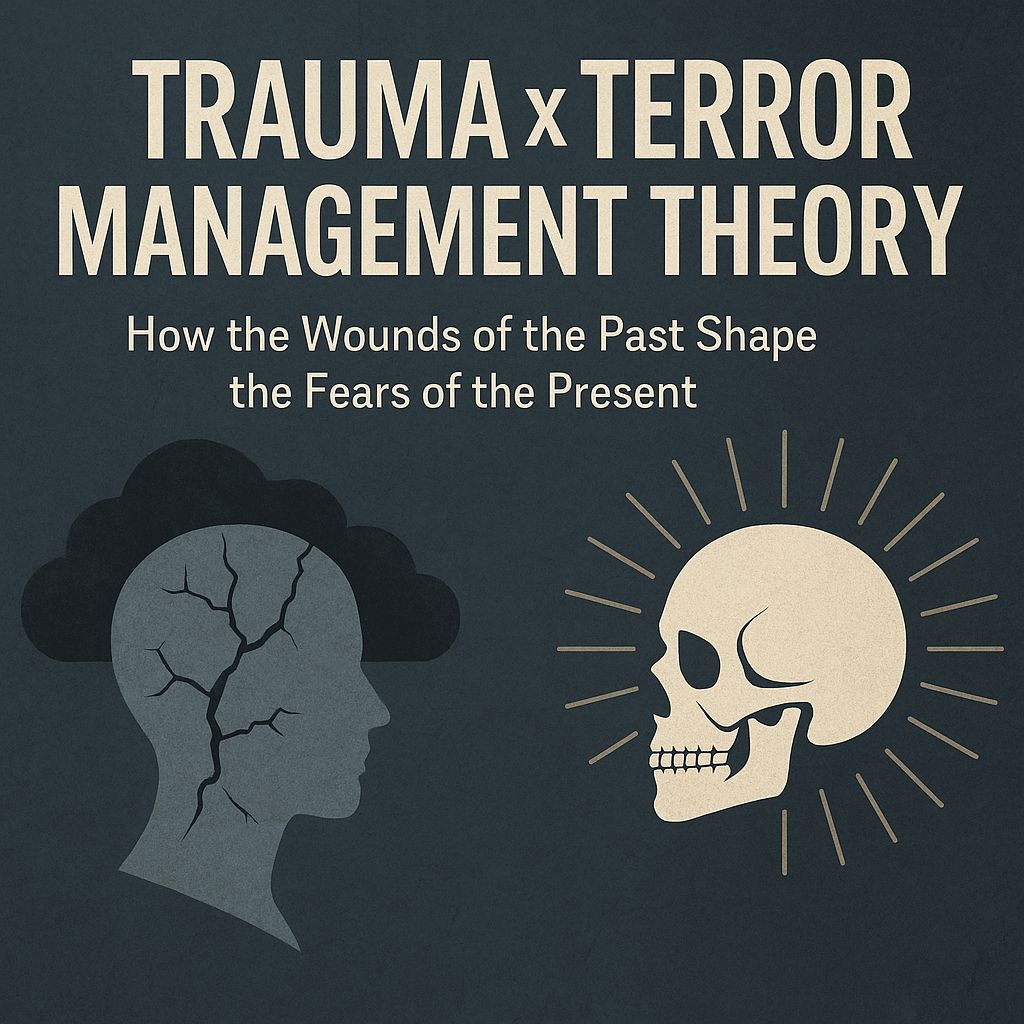
🌫️ Trauma x Terror Management Theory
How the Wounds of the Past Shape the Fears of the Present
1. Trauma Lowers the Threshold for Mortality Salience
TMT says people react strongly when reminded of death, vulnerability, or uncertainty.
Trauma makes that button much easier to press because it:
- sensitizes the nervous system
- teaches the body that danger can strike unexpectedly
- makes the mind hyper-attuned to threats
This means traumatized individuals may experience mortality salience even when nothing explicitly references death.
A stressful headline, an angry social media post, cultural change, a new law, or a chaotic news cycle can all trigger echoes of earlier danger.
Influencers do not necessarily need to mention death directly. Trauma has often already primed the system.
🌬️ 2. Trauma Disrupts Identity (and Identity is the Shield in TMT)
TMT suggests people rely on culture, identity, worldviews, and group belonging as buffers against existential fear.
Trauma often fractures or distorts identity.
- Childhood trauma → “I am unworthy.”
- Social oppression → “My group is unsafe.”
- Abandonment → “I must attach to something stronger.”
- Bullying → “The world hates people like me.”
When identity feels unstable, people may cling more tightly to rigid worldviews, belonging systems, and certainty.
Trauma makes identity fragile. TMT suggests fragile identity increases fear. Fear increases tribalism.
It becomes a loop.
🔥 3. Trauma Turns Discomfort Into Threat
TMT proposes that people defend worldviews when those worldviews feel threatened.
Trauma adds another layer: the nervous system may struggle to distinguish discomfort from danger.
- Disagreement feels dangerous.
- Cultural change feels dangerous.
- Opposing viewpoints feel dangerous.
- Difference itself can feel dangerous.
This creates fertile ground for fear-based persuasion and outrage-driven narratives.
🧠 4. Trauma Makes People Vulnerable to Manufactured Narratives
TMT predicts that existential vulnerability increases attachment to meaning systems.
Trauma predicts that unresolved fear creates a search for stories that provide:
- validation
- protection
- belonging
- certainty
- a sense of power
This can increase attraction toward cult-like communities, conspiratorial systems, extremist ideologies, and parasocial relationships.
Trauma asks: "Why did the world hurt me?"
TMT asks: "How do I protect myself from the fear underneath?"
💥 5. Trauma Makes People Interpret Ambiguity as Hostility
Trauma often interprets uncertainty through a threat lens.
Messages such as:
- “They’re coming for your rights.”
- “They’re destroying your culture.”
- “They want to replace you.”
may not be processed symbolically. They can be experienced as immediate survival threats.
Under the right conditions this can escalate into panic, scapegoating, hatred, and dehumanization.
🧩 6. Trauma + TMT Creates Predictable Culture-Wide Patterns
High collective trauma loads can contribute to:
- authoritarian longing
- rage politics
- purity movements
- conspiracy cultures
- identity polarization
- nostalgia fantasies
- moral panics
- demonization of outsiders
- strong-protector leader narratives
Trauma shapes identity. TMT helps explain why threatened identities become defensive. Influencers and institutions can exploit both dynamics.
☀️ 7. What Heals Trauma Weakens TMT Havoc
Many factors that help heal trauma also reduce fear-driven reactions:
- grounding
- community safety
- vulnerability without shame
- self-reflection
- secure attachments
- curiosity over certainty
- nuance over tribalism
- integrating pain rather than weaponizing it
- hearing diverse perspectives in non-hostile spaces
As identity stabilizes, fear becomes harder to weaponize.
🌱 Big Takeaway
Trauma makes people easier to trigger.
Terror Management Theory helps explain why those triggers can evolve into tribal reactions, defensive identities, and worldview battles.
Fear-based narratives often exploit both.
Humility, grounded identity, community, reflection, and psychological safety can interrupt the cycle.
A stable person is far more difficult to manipulate through fear.