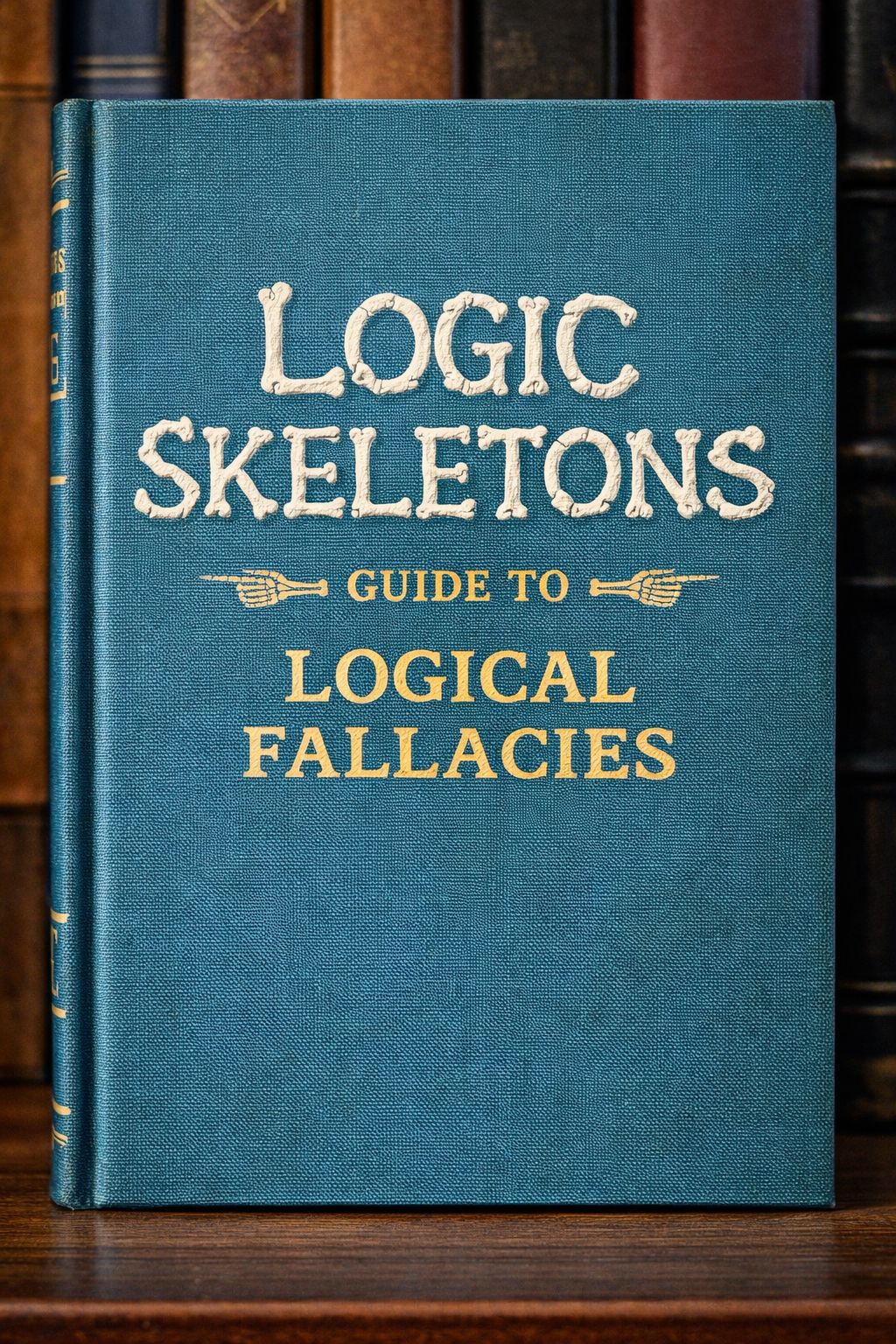
🧠 LOGIC SKELETONS
Guide to Logical Fallacies
(A field manual for broken reasoning pathways)
You’re looking at the full zoo of mental traps… but instead of cages, we’re mapping bones and joints 🦴
Every argument should look like this:
(premises → reasoning → conclusion)
A fallacy is what happens when that structure gets warped, skipped, or hijacked.
⚔️ 1. Attack-Based Fallacies
The argument gets replaced with the person.
Instead of evaluating the conclusion, the system attacks the speaker.
Truth of a claim is not determined by traits of the person making it.
🎭 2. Emotional Manipulation Fallacies
Emotion replaces reasoning.
Fear, pity, outrage, pride, and panic become substitutes for evidence.
Emotion can influence belief, but it does not verify truth.
🧱 3. Assumption & Premise Fallacies
The corruption begins before reasoning even starts.
If the foundation is flawed, the conclusion inherits the damage.
Hidden assumptions quietly smuggle conclusions into the premises.
🔄 4. Cause & Effect Fallacies
Arrows become miswired.
Sequence alone does not establish causation.
Complex systems usually involve multiple interacting causes.
🧩 5. Logic Structure Failures
The internal wiring collapses.
The same outcome can emerge from many different causes.
Conclusions fail when logical flow between steps breaks apart.
🎯 6. Misrepresentation Fallacies
The original argument gets distorted before evaluation.
A weakened or exaggerated version replaces the real position.
The attack succeeds only because the target was altered first.
📢 7. Authority & Social Proof Fallacies
External signals replace reasoning.
Influence and truth are not identical systems.
Popularity may spread ideas, but it does not validate them.
🧮 8. Generalization Errors
A small sample becomes a universal conclusion.
A few experiences cannot automatically represent an entire system.
🎲 9. Probability & Statistical Fallacies
Math intuition goes rogue.
Random systems do not “owe” balance in the short term.
🧠 10. Language & Ambiguity Fallacies
Words quietly shift meaning mid-stream.
Arguments break when identical wording hides changing definitions.
🪞 11. Meta / Rhetorical Traps
The game board itself changes.
Goalposts move. Topics divert. Burdens shift.
The objective becomes control of the conversation rather than pursuit of truth.
🧱 FINAL CORE IDEA
Logical fallacies are not random mistakes.
They are compressed reasoning shortcuts that emerge under pressure:
Every fallacy reduces to one of four breakdowns:
Bad Input.
Bad Process.
Bad Mapping.
Bad Framing.
The goal is not merely to argue better.
The goal is to notice when the structure breaks.
← Close Book...