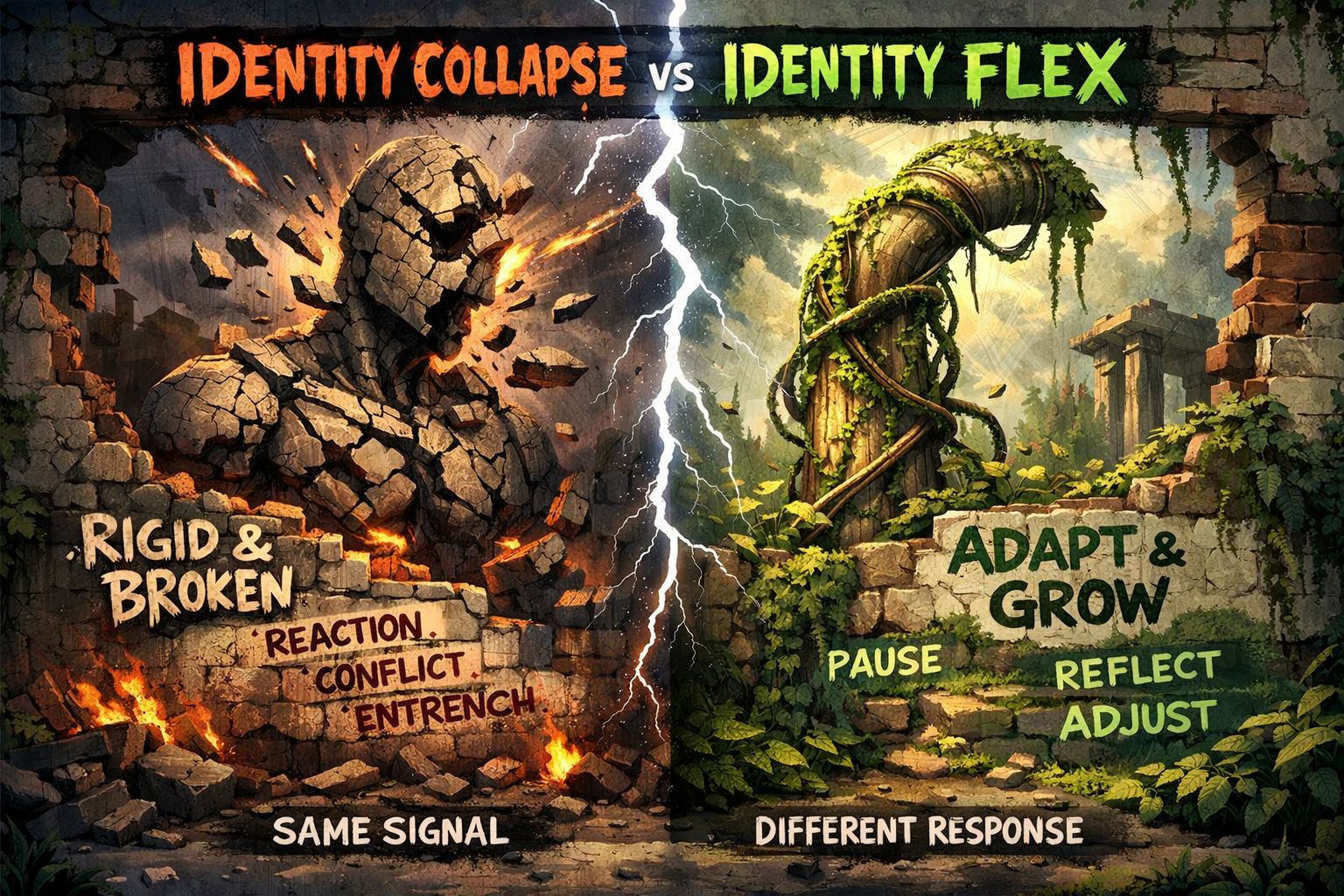
🧠 IPT: IDENTITY UNDER STRESS
COLLAPSE vs FLEX MODEL
“Same trigger. Two completely different outcomes.”
⚠️ ENTRY CONDITION
Something hits the system:
📡 criticism
📡 contradiction
📡 exclusion
📡 humiliation
📡 loss of status
📡 uncertainty
👉 Identity is activated
🧱 PATH 1 — IDENTITY COLLAPSE
Rigid structure meets pressure
⚙️ PHASE 1 — THREAT DETECTION
🧠 “This challenges who I am.”
Signal is interpreted as:
👉 danger to self
(not just disagreement)
⚡ PHASE 2 — FUSION SPIKE
Identity fuses with:
- belief
- group
- role
- moral stance
👉 “This IS me”
No separation between: idea ≠ self
🔥 PHASE 3 — DEFENSIVE IGNITION
System mobilizes:
- anger
- certainty
- urgency
- righteousness
👉 emotional velocity spikes
⚔️ PHASE 4 — CONFLICT EXPRESSION
Behavior escalates:
- argument becomes battle
- disagreement becomes threat
- other becomes enemy
🧱 PHASE 5 — RIGID LOCK
System reinforces itself:
- no new input accepted
- contradiction rejected
- narrative hardens
👉 “I must be right to remain intact”
🪦 PHASE 6 — COLLAPSE OR ENTRENCHMENT
Two outcomes:
A. 💥 breakdown (identity fracture, shame spiral)
B. 🧱 entrenchment (extreme rigidity, tribal lock-in)
📡 IPT TRANSLATION (COLLAPSE PATH)
signal → identity fusion → threat → defense → conflict → rigidity
👉 low flexibility
👉 high reactivity
👉 high manipulation risk
🌿 PATH 2 — IDENTITY FLEX
Adaptive structure meets pressure
⚙️ PHASE 1 — SIGNAL RECOGNITION
🧠 “Something is being activated.”
Pause before interpretation.
🧩 PHASE 2 — SEPARATION
Key move:
👉 self ≠ idea
👉 self ≠ role
👉 self ≠ reaction
🧠 PHASE 3 — VELOCITY REDUCTION
System slows:
- breath stabilizes
- reaction delayed
- observation increases
👉 emotional speed drops
🔍 PHASE 4 — MULTI-LAYER AWARENESS
Instead of one identity:
- “part of me feels this”
- “another part sees differently”
👉 internal flexibility increases
🌱 PHASE 5 — INTEGRATION
System processes:
- contradiction allowed
- new info considered
- identity adjusts slightly
👉 no fracture required
🔄 PHASE 6 — ADAPTIVE UPDATE
Identity evolves:
- expands
- refines
- repositions
👉 continuity maintained
📡 IPT TRANSLATION (FLEX PATH)
signal → pause → separation → observation → integration → adaptation
👉 high flexibility
👉 low reactivity
👉 low manipulation risk
⚖️ SIDE-BY-SIDE CORE DIFFERENCE
COLLAPSE
self = belief
instant reaction
threat interpretation
rigid identity
conflict escalation
stability through force
FLEX
self contains belief
delayed response
signal observation
layered identity
integration
stability through adaptation
🧠 CRITICAL INSIGHT
Both paths start at the same place:
👉 activation
The difference is not intelligence.
The difference is:
👉 identity flexibility under pressure
💣 WHY THIS MATTERS (OUTRAGE SYSTEM)
Outrage systems exploit collapse:
- fuse identity to position
- trigger threat
- accelerate reaction
- reward escalation
👉 collapse becomes profitable
🧊 IPT INTERVENTION POINTS
To shift collapse → flex:
-
🧠 NAME THE ACTIVATION
“This feels like a threat to me” -
🧩 CREATE SEPARATION
“I am not the same as this reaction” -
⏱ SLOW THE SYSTEM
delay response
reduce velocity -
🔍 EXPAND PERSPECTIVE
multiple interpretations allowed -
🌱 ALLOW ADJUSTMENT
identity can move without breaking
🐺 HELLHOUND POSITION
The Hellhound does not stop conflict.
It detects:
📡 where fusion occurred
📡 where velocity spiked
📡 where identity locked
It watches for:
👉 the exact moment flexibility was lost
🔚 FINAL LINE
Identity collapse tries to survive by becoming rigid.
Identity flex survives by remaining adjustable.
“same signal”
“different structure”