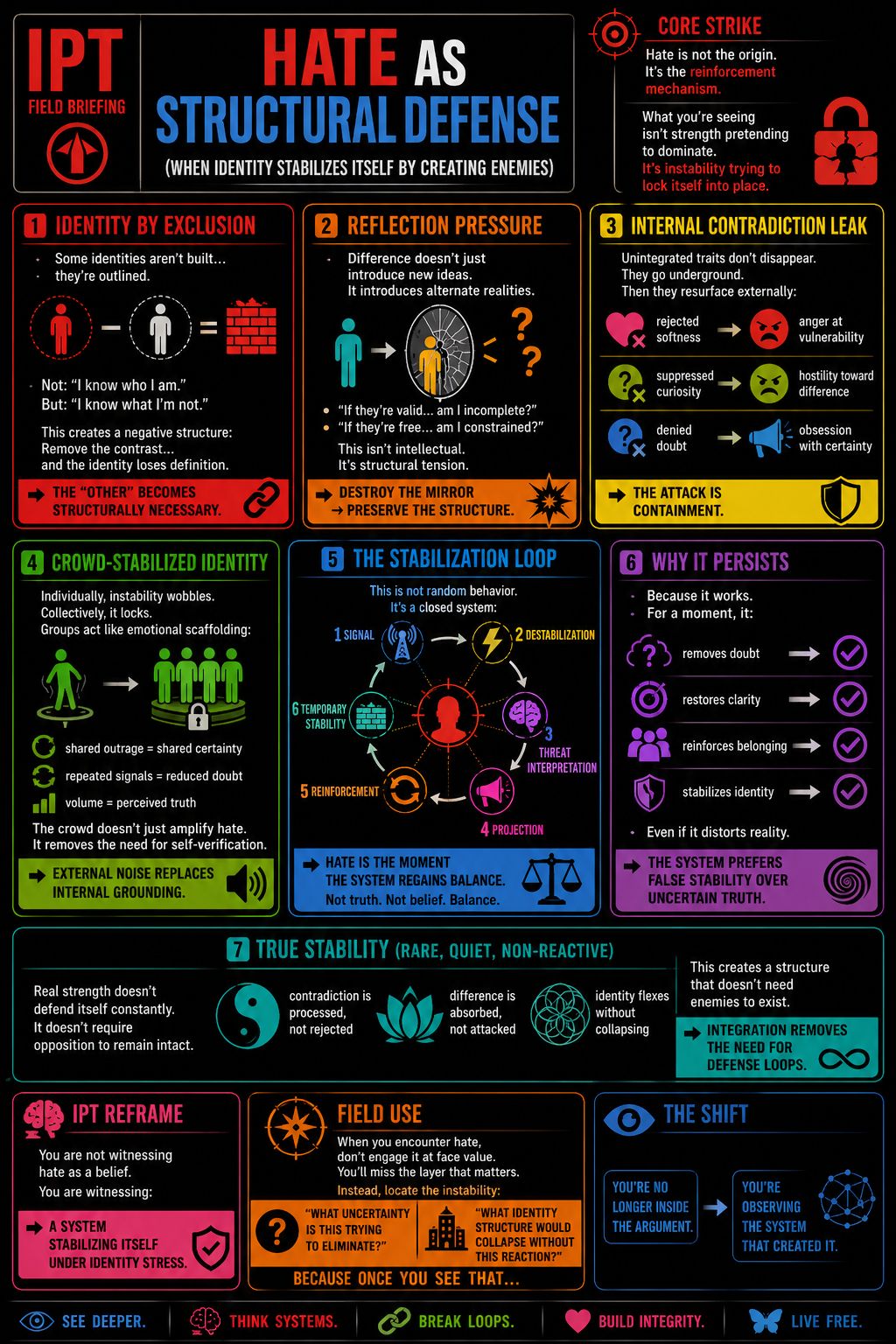
🧠 IPT FIELD BRIEFING
HATE AS STRUCTURAL DEFENSE
(When identity stabilizes itself by creating enemies)
⚠️ CORE STRIKE
Hate is not the origin.
It’s the reinforcement mechanism.
What you’re seeing isn’t strength pretending to dominate.
It’s instability trying to lock itself into place.
🧱 1. IDENTITY BY EXCLUSION
Some identities aren’t built…
they’re outlined.
Not:
“I know who I am.”
But:
“I know what I’m not.”
This creates a negative structure:
Remove the contrast…
and the identity loses definition.
👉 The “other” becomes structurally necessary.
🪞 2. REFLECTION PRESSURE
Difference doesn’t just introduce new ideas.
It introduces alternate realities.
And that creates a silent destabilizer:
- “If they’re valid… am I incomplete?”
- “If they’re free… am I constrained?”
This isn’t intellectual.
It’s structural tension.
So the system resolves it the fastest way possible:
Not by updating itself…
but by invalidating the reflection.
👉 Destroy the mirror → preserve the structure.
🧩 3. INTERNAL CONTRADICTION LEAK
Unintegrated traits don’t disappear.
They go underground.
Then they resurface externally:
- rejected softness → anger at vulnerability
- suppressed curiosity → hostility toward difference
- denied doubt → obsession with certainty
What looks like moral judgment…
is often internal contradiction trying to stay buried.
👉 The attack is containment.
📢 4. CROWD-STABILIZED IDENTITY
Individually, instability wobbles.
Collectively, it locks.
Groups act like emotional scaffolding:
They don’t just agree…
they synchronize.
- shared outrage = shared certainty
- repeated signals = reduced doubt
- volume = perceived truth
The crowd doesn’t just amplify hate.
It removes the need for self-verification.
👉 External noise replaces internal grounding.
⚡ 5. THE STABILIZATION LOOP
This is not random behavior.
It’s a closed system:
📡 signal
→ ⚡ destabilization
→ 🧠 threat interpretation
→ 📢 projection
→ 🔁 reinforcement
→ 🧱 temporary stability
And here’s the shift:
👉 Hate is the moment the system regains balance.
Not truth.
Not belief.
Balance.
🌪️ 6. WHY IT PERSISTS
Because it works.
For a moment, it:
- removes doubt
- restores clarity
- reinforces belonging
- stabilizes identity
Even if it distorts reality.
👉 The system prefers false stability over uncertain truth.
🌱 7. TRUE STABILITY
Rare, quiet, non-reactive
Real strength doesn’t defend itself constantly.
It doesn’t require opposition to remain intact.
It operates differently:
- contradiction is processed, not rejected
- difference is absorbed, not attacked
- identity flexes without collapsing
This creates a structure that doesn’t need enemies to exist.
👉 Integration removes the need for defense loops.
🧠 IPT REFRAME
You are not witnessing hate as a belief.
You are witnessing:
👉 a system stabilizing itself under identity stress
🧭 FIELD USE
When you encounter hate, don’t engage it at face value.
You’ll miss the layer that matters.
Instead, locate the instability:
👉 “What uncertainty is this trying to eliminate?”
👉 “What identity structure would collapse without this reaction?”
Because once you see that…
You’re no longer inside the argument.
You’re observing the system that created it.