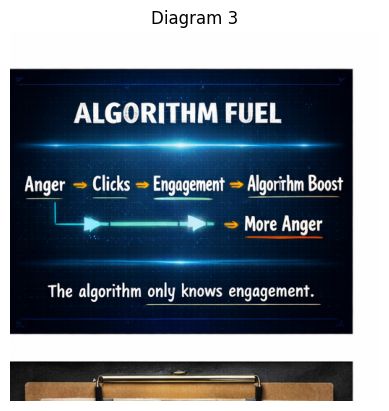
This diagram shows how the platform itself amplifies emotional content.
It’s not about ideology or politics. It’s about how engagement systems work.
Think of the algorithm like a thermostat that only measures heat, not the quality of the fire. 🔥
If something produces a lot of heat, the system assumes it must be important.
Anger
Anger is one of the strongest engagement emotions.
When people feel anger they tend to:
- comment immediately
- share with their tribe
- argue in the comments
- screenshot and repost
Anger activates people faster than calm information.
From the platform’s perspective, anger is high-energy behavior.
Clicks
When anger is triggered, people click.
Clicks include:
- opening the post
- expanding comments
- clicking the article
- tapping reaction buttons
Each click sends a signal to the system:
“This content is interesting.”
The algorithm can’t read the emotion behind the click. It only sees activity.
Engagement
Engagement is the scoreboard of the platform.
Examples:
- comments
- shares
- reactions
- watch time
- replies in threads
The more engagement a post receives, the more the system believes:
“People want to see this.”
Even arguments count as engagement.
In fact, arguments often produce more activity than agreement.
Algorithm Boost
Once engagement crosses certain thresholds, the platform increases distribution.
This is the boost phase.
The content gets shown to:
- more followers
- friends of people engaging
- suggested feeds
- recommendation systems
The post spreads wider and faster.
More Anger
Now a feedback loop appears.
More exposure means:
- more people encounter the post
- more emotional reactions
- more arguments
- more engagement
Which tells the algorithm to boost it again.
So the cycle becomes:
Anger → Clicks → Engagement → Boost → More Anger
It’s a self-amplifying loop.
The Line at the Bottom
“The algorithm only knows engagement.”
This means the system isn’t judging:
- truth
- fairness
- emotional health
- social harmony
It only measures behavioral activity.
If people react strongly, the system interprets that as success.
Why This Matters for IPT
Identity Panic Toolkit focuses on disrupting engagement loops.
When people respond with:
- calm
- curiosity
- silence
- non-participation
the engagement cycle weakens.
No engagement → no boost.
Without the boost, the outrage content loses reach.
So this diagram shows something subtle:
The outrage economy doesn’t run only on ideas or beliefs.
It runs on behavior signals.
And the smallest signal in that system is simply your attention.